
How to treat and protect outdoor wood: 7 methods for long-lasting results
- 1. How to effectively protect exterior wood? An overview of effective methods
- 1.1. Wood oils – natural protection from within
- 1.2. Wood stains and dyes – lasting colour and protection in one
- 1.3. Impregnation and biological protection
- 1.4. Varnishes and polyurethanes
- 1.5. Exterior paints
- 1.6. Wood stains
- 1.7. Special and innovative methods
- 2. Summary
Wood is one of the most natural and aesthetic materials used in the garden – from gazebos and terraces to furniture and fences. However, its charm goes hand in hand with sensitivity to moisture, sun, changing temperatures and biological factors, which over time lead to greying, cracking or rotting. Therefore, proper protection of wood outdoors is not a choice but a necessity. In this guide, we have compiled proven methods for protecting wood – from classic oils and impregnants to modern protective systems – to help you preserve its durability and beauty for years to come.
How to effectively protect exterior wood? An overview of effective methods
Before you reach for the first wood product you see, it is worth understanding the differences between the various protection methods and how they work. Below, we present the most effective ways to protect wood outdoors – from classic oils to modern multi-layer systems.

1. Wood oils – natural protection from within
Oiling is one of the most popular methods of protecting wood outdoors, especially for elements where a natural look and grain structure are important. Unlike paints or varnishes, oil does not form an outer coating but penetrates deep into the wood, stabilising its moisture content and protecting it from the inside. This allows the wood to ‘breathe’ and retain its natural character and satin sheen.
The most popular oils include linseed, tung and Danish oil – easy to apply, but requiring regular renewal every 3–12 months, depending on weather conditions. It is also worth considering oils enriched with resins and UV filters, which form a durable water-repellent layer and protect the wood more effectively against sunlight and moisture, especially on surfaces such as garden furniture, terraces, planters and balustrades.
BHB expert advises:
Oiling wood is one of the easiest and most intuitive methods of care – but only if the wood is properly prepared. Failure to sand or application to damp wood can completely ruin the effect.
Practical tips:
- before oiling, the wood should be thoroughly cleaned and dried – ideally, its moisture content should not exceed 20%.
- it is recommended to apply thin layers with a brush or soft cloth, along the grain.
- after the recommended absorption time (approx. 15–30 minutes), excess oil should be removed to prevent a sticky surface from forming.
- for best protection, apply 2–3 coats at intervals of several hours.
Although oiling requires regular maintenance, it has the advantage of not requiring the entire surface to be sanded down before reapplication. Only worn areas need to be refreshed, making this method particularly practical for users who value convenience and aesthetics.
2. Wood stains and dyes – lasting colour and protection in one
Wood stains and dyes are popular protective agents that not only protect the wood but also give it a deep, decorative colour, emphasising the natural grain. They penetrate the wood structure, so they do not peel or crack, which makes them particularly valuable for heavily used surfaces such as fences, garden furniture and gazebos.
Wax stains further enhance the wood’s resistance to water, and modern dyes with UV filters ensure long-lasting colour and protection against fading for up to 2-3 years. They are a good choice for those who want to combine aesthetics with practical protection, especially if they want to preserve the natural structure of the wood without the effect of an ‘artificial’ coating.
BHB expert advises:
Wood stain is ideal where appearance is as important as protection – it can be easily combined with varnish, glaze or oil. However, remember that wood stain does not have biocidal properties – before using it, it is worth applying a protective primer.
Practical tips:
- before staining, the wood must be thoroughly sanded and dusted – only then will the colour be even.
- apply in thin layers, along the grain, preferably with a brush or cotton pad.
- depending on the product, 2–3 coats can be applied for a deeper colour.
- once the stain has dried, it is advisable to protect the surface with varnish or glaze – this will improve its durability and resistance to weather conditions.
Stains and dyes are an excellent choice if you want to combine aesthetics with practical protection while maintaining the natural, wooden character of the surface.
3. Impregnation and biological protection
Wood preservatives are one of the most effective methods of biological protection, especially for elements exposed to moisture, contact with the ground or limited ventilation, such as fences, platforms, gazebos or structural posts. Unlike varnishes or paints, they do not form a layer on the surface, but penetrate deep into the structure of the wood, where they protect it from the inside against blue stain, mould, fungi and insects. Thanks to them, the wood retains its mechanical and aesthetic properties for many years.
Impregnating agents are available in both colourless and coloured versions. The former are recommended when you want to preserve the natural colour of the wood, while the coloured ones often contain additives that enhance UV protection. Modern oil-based impregnants are also available, which provide deeper penetration and can replace additional protective layers. Products based on ACQ or CuAz formulas (free of toxic heavy metals) meet current EU and UK standards, offering high effectiveness without harming the environment.
BHB expert advice:
Impregnating agents can never replace a fully abrasion-resistant coating, but they do provide deep biological protection and should always be the first step in protecting wood, especially in garden structures or structures exposed to contact with the ground.
Practical tips:
- apply to raw, dry wood: Moisture prevents the impregnating agent from being absorbed properly – the wood should have a moisture content of less than 20%.
- always start with impregnation: If you plan to use a stain, varnish or paint, protect the wood biologically first.
- ensure thorough coverage: The ends of boards and horizontal elements are particularly important, as they absorb water most easily.
- do not apply to old layers of paint/varnish: The impregnating agent must penetrate the structure, so the surface must be clean and free of barrier coatings.
- renew the protection regularly: Even deeply penetrating impregnating agents lose their effectiveness after a few years – refreshing every 2–5 years is a sensible practice.
Impregnation provides a solid ‘foundation’ for protection – and well-prepared wood better accepts subsequent decorative and protective layers, such as oils or glazes.
4. Varnishes and polyurethanes
Varnishes and polyurethanes are products that form an external, flexible protective coating that protects wood from UV radiation, moisture and mechanical damage. They are a particularly good choice for architectural elements exposed to changing weather conditions, such as windows, doors, balustrades and garden furniture.
When choosing a varnish, it is worth opting for a version designed for outdoor use, such as satin or glossy. Oil-based polyurethanes offer exceptional durability, although they form a slightly stiffer coating than oils or impregnants. The key to success is a solid substructure – a clean, smooth and properly primed surface.
BHB expert advises:
Varnishes require proper preparation of the substrate. Even the best product will not work if applied to a non-sanded or damp surface.
Practical tips:
- Sand the wood with 120–180 grit sandpaper before varnishing.
- Apply the varnish in thin layers, following the direction of the grain.
- Do not use in strong sunlight – this may cause blistering.
- Renew every 3–5 years, depending on weather exposure.
5. Exterior paints
Exterior paints are an excellent choice if you want not only to protect the wood, but also to achieve full coverage and intense colour. They form a thicker, pigmented coating that acts as a barrier against moisture and UV radiation. They are a great solution for painting fences, planters, gazebos and wooden facades.
Compared to oils or varnishes, paints are more resistant to abrasion, but completely cover the natural grain of the wood. They are ideal where colour aesthetics and durability are a priority and the natural appearance of the grain is not so important.
BHB expert advises:
Paint is not only colour, but also a protective barrier. A well-chosen primer is essential – without it, the paint can quickly peel and flake off.
Practical tips:
- use a primer before painting, especially on soft woods.
- paint at a temperature of 10–25°C, avoiding heat.
- before repainting, sand down the old coating if it has started to flake.
- renew every 3–5 years or as recommended by the manufacturer.
6. Wood stains
Wood stains combine the advantages of varnishes and impregnants – they provide a light protective coating with a subtle sheen, while gently penetrating the wood. They are transparent or semi-transparent, allowing the natural appearance of the grain to be preserved and emphasised.
Lazura is best suited for decorative elements: pergolas, planters, gazebos, balustrades. However, it should be remembered that lazura alone does not protect against fungi or insects – therefore, it should only be used on previously impregnated wood.
BHB expert advises:
Lazura is ideal for elements that are not heavily used. It is essential to protect the wood with an impregnating agent beforehand.
Practical tips:
- before applying the lasure, use a colourless biological impregnating agent.
- apply 2–3 thin coats, preferably with a brush or spray.
- renew every 2 years, especially after winter.
- avoid use on horizontal wood (e.g. terrace floors).
7. Special and innovative methods
Acetylation is a modern chemical method of permanent wood modification, involving a change in its cell structure. This gives the wood increased resistance to moisture, fungi and changing weather conditions – without the need for additional protective measures.
An example is Accoya wood, which, thanks to acetylation, gains a durability comparable to tropical species. Importantly, the process does not require the use of toxic substances, making it an environmentally friendly solution.
Practical tips:
- Buy wood that has already been acetylated (e.g. Accoya) – it cannot be done on your own.
- Ideal for windows, doors, facades and large investments.
- Does not require regular impregnation or varnishing.
- Higher price, but significantly lower maintenance costs in the future.
Epoxy + varnish
The epoxy + varnish system is a solution for demanding applications – used where wood is exposed to very harsh conditions: e.g. around swimming pools, on boats and in modern garden architecture. First, epoxy is applied as a deep sealant, followed by a layer of protective varnish.
The advantage of this system is not only its durability, but also the almost complete impermeability of the surface, which protects the wood from water and dirt for years. However, it requires experience in application and very good quality products.
Practical tips:
- apply epoxy only to dry and degreased wood.
- use a suitable mask and ventilation – the products may have a strong odour.
- ideal for wood exposed to constant contact with water.
- requires precision – any imperfections may later affect the durability of the coating.
Summary
Garden wood is a beautiful and natural material, but it requires regular care to maintain its appearance and properties for many years. Proper protection protects it from moisture, UV radiation, mould, fungi and pests.
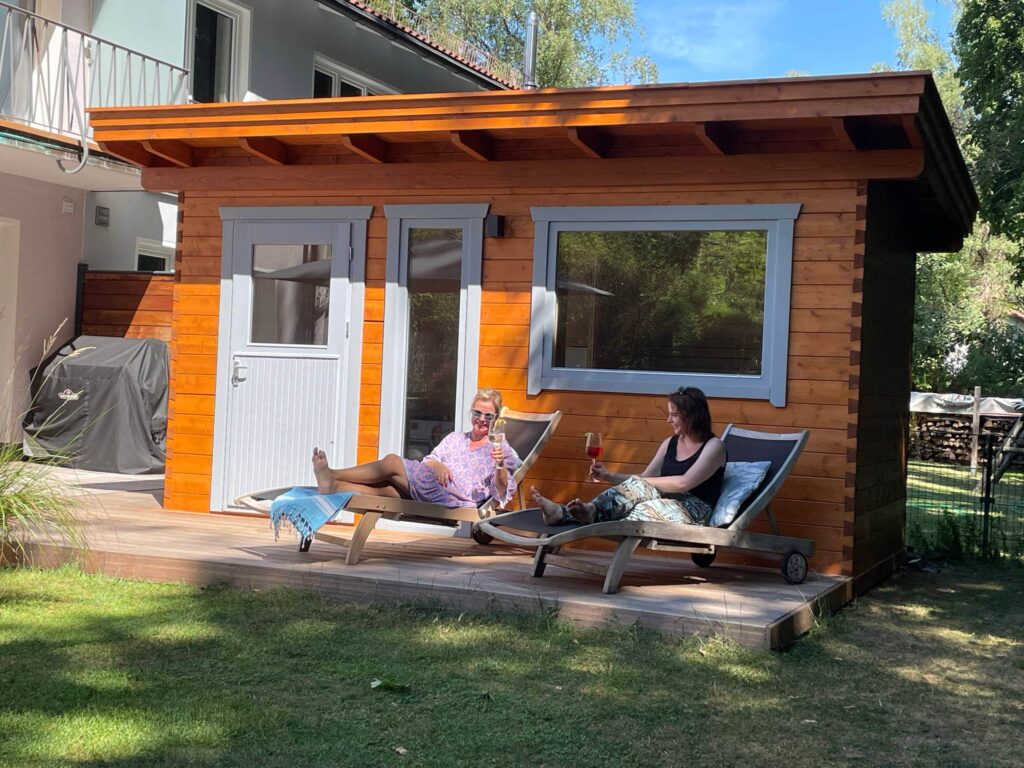
At BHB, we not only design and manufacture garden structures, e.g.: modern garden rooms or garden houses, but also advise on how to care for them. Thanks to this, our robust and timeless gazebos and pergolas not only look good on the day of installation, but also remain beautiful and durable for many seasons. Each of our solutions is a combination of aesthetics, functionality and material awareness.