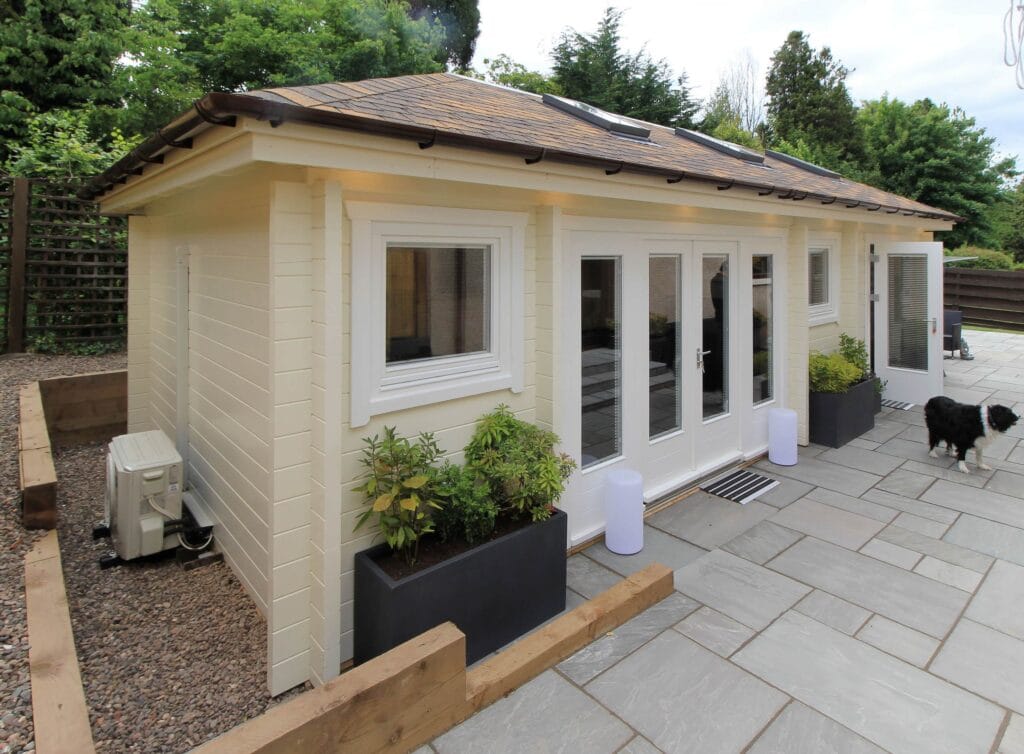

Ground screws for a garden room
- 1. What is a screw foundation?
- 2. Why are screw foundations a good choice for a garden room?
- 2.1. Disadvantages and limitations to keep in mind
- 3. When should screw piles be used?
- 4. How to install a screw foundation yourself?
- 5. Screw foundations and the environment
- 6. BHB customer case study – a house on a screw foundation
- 6.1. How was the ground prepared?
- 7. Summary
- 7.1. FAQ
In today’s garden construction, we are increasingly abandoning traditional, heavy concrete foundations in favour of modern solutions. One of them is the screw pile foundation – lightweight, quick to install and environmentally friendly. In this article, we present what exactly a screw pile foundation is, when it is worth using, what its advantages and disadvantages are, and how to install it yourself.
What is a screw foundation?
A screw foundation, also known as a screw pile or ground screw, is a steel structure shaped like a giant screw that is screwed into the ground without the need for digging or concreting. It consists of three main parts:
- a shaft – a steel pipe that is driven into the ground,
- a helical plane – a spiral part that ensures stability in the ground,
- a fastening head – to which the structure of the house is attached.
Foundation screws are most often made of hot-dip galvanised steel, which ensures their corrosion resistance and longevity. Thanks to their design, these screws work similarly to wall plugs – they stabilise in the ground by screwing in.

Why are screw foundations a good choice for a garden room?
If you are planning to build a garden shed or garden room and want a quick, clean and hassle-free solution, screw foundations may be just what you are looking for. They are a modern alternative to concrete, suitable for both simple DIY projects and more demanding ground conditions.
Here are the most important advantages of screw foundations:
- quick and hassle-free installation – no digging, mixing concrete or waiting for it to set. Installation can be completed in as little as one day.
- low cost – no need to hire heavy equipment or a concrete mixer, which means real savings.
- can be installed by one person – all you need is a manual screwdriver or a special drill bit.
- weather resistance – galvanised steel protects against corrosion, and the raised construction protects the shed from ground moisture.
- minimal interference with the soil structure – ideal for plots with trees, vegetation or underground infrastructure.
- reusable – the foundation can be rotated and reused, e.g. after moving house.
- no mud or noise – screw foundations can be installed cleanly, quietly and without mess on the plot.
Interesting fact:
The technology of screw foundations dates back to the 19th century – it was used, among other things, to build lighthouses on difficult, marshy terrain. Today, thanks to technological advances, it is one of the most popular solutions for garden rooms, gazebos, terraces and modular structures.
Disadvantages and limitations to keep in mind
Although screw foundations have many advantages, it is important to be aware of their limitations, especially for larger or unusual projects:
- less stable for very large structures – e.g. year-round houses may require deeper foundations or additional reinforcement.
- they require soil analysis – on peaty, wet or loose soils, it is advisable to consult an expert before installation.
- some models may require specialised tools – e.g. for larger screw diameters.
- precise levelling is essential for the stability of the entire structure, especially on uneven ground.
BHB expert advice:
For most garden houses, standard screws and basic tools are sufficient, but for soils with uncertain load-bearing capacity, we recommend a test screw or consultation with a contractor. This is a small cost that can prevent problems in the future.
When should screw piles be used?
Screw foundations are a versatile solution that can be used in many situations, especially where traditional methods would be too invasive, expensive or simply impossible to use. They are ideal for both private and commercial applications.
Here are some examples of when screw piling is particularly worth considering:
- building a garden room, tool shed or gazebo – quick installation without excavation or concrete saves time and does not damage the surrounding greenery.
- installation of terraces, pergolas, sheds or greenhouses – especially in areas with variable ground levels or numerous underground obstacles (e.g. roots, installations).
- seasonal and temporary installations – ideal for summer houses, pavilions or market stalls that are portable. The piles can be easily unscrewed and reused in a different location.
- recreational plots without access for heavy equipment – the piles can be carried in and installed by hand, without the need for an excavator or concrete mixer.
- areas under nature conservation or requiring delicate intervention (e.g. landscape parks, plots with trees) – piling does not disturb the soil structure, does not affect drainage and can be used near root systems.
Good to know:
In many municipalities and forest areas, screw foundations are even recommended as a form of temporary construction, which can reduce formal requirements and facilitate the start of construction.
How to install a screw foundation yourself?
The installation of a screw foundation is so simple that in many cases it can be done on your own – without the need for heavy equipment, a construction crew or expensive earthworks. It is a great option for DIY enthusiasts, gardeners and anyone who wants to quickly and cleanly build a stable base for a garden shed, terrace or shed. Below is a simple step-by-step guide:
Step 1: Selecting the right screws
Select the length and diameter of the screws for your planned structure and soil type. The heavier the load or the less stable the soil, the longer and thicker the piles should be.
Example: for a light 3 × 3 m tool shed on medium-bearing ground, 6–8 screws with a length of 90 cm and a diameter of 68–76 mm are sufficient.
Step 2: Marking the installation points
Plan the distribution of the screws according to the design of the shed. The points should be evenly spaced at the corners and in the middle of each wall to distribute the weight evenly. Use a string and a tape measure to mark out a rectangular grid.
Step 3: Screw the screws into the ground
Using a hand-held screw pile driver (or a drill adapter), screw the screws vertically into the ground. Initially, drive the pile in by hand to anchor it, then continue turning.
Tip: The screw should go in at least 60–80 cm to ensure stability.
Step 4: Levelling
Once all the screws have been screwed in, use a spirit level or laser leveller to ensure that all the heads are at the same level. If necessary, the screw can be tightened (or loosened slightly). It is also worth checking the diagonals – equal lengths guarantee a perfect rectangle.
Step 5: Mounting the heads and screwing the structure together
Metal heads (e.g. U-shaped or flat) are mounted on each screw and adjusted to the wooden joists or steel frame. The heads are fastened to the structure with screws and nuts or screws. From this point on, you can start assembling your shed!
Screw foundation installation: worth a try!
Installing a screw foundation not only saves time and money, but also gives you a great sense of satisfaction. Unlike concrete solutions, you don’t have to wait for the concrete to set, and there is no mess or risk of damaging your lawn. In many cases, the assembly can be completed in a single day – even by one person. It is a solution that combines modernity with practicality – which is why we are increasingly using it in our projects at BHB.
Screw foundations and the environment
In an era of growing environmental awareness, more and more investors – both private and commercial – are looking for environmentally friendly solutions. Screw foundations are definitely one of them. Unlike traditional concrete foundations, they do not require the use of cement, a raw material whose production accounts for approximately 8% of global CO₂ emissions. This means that greenhouse gas emissions can be reduced right from the foundation stage.
Additionally, ground screws:
- do not require water, sand, gravel or heavy construction equipment,
- do not disturb the natural drainage of the soil – which protects vegetation and microorganisms,
- can be completely removed and reused – without leaving waste or concrete in the ground,
- minimise interference with the root system – which is important, for example, in protected areas or under trees.
Environmental facts:
- Cement is the third largest source of CO₂ emissions in the world (after coal and oil). This is why building authorities in Europe are increasingly promoting ‘green foundations’, including screw piles.
- In Germany and the United Kingdom, local guidelines recommending ground screws as the preferred technology in environmentally sensitive areas, such as near Natura 2000 sites, are becoming increasingly common.
- In temporary projects (e.g. outdoor installations, event halls, containers), screws allow for quick assembly and disassembly without leaving any traces in the ground, making them the ideal choice for event organisers or owners of seasonal plots.
As a result, screw foundations not only simplify construction and speed up investment, but also contribute to environmental protection – which for many modern customers is just as important as durability or price. At BHB, we are also increasingly using this solution in projects focused on sustainable development.
BHB customer case study – a house on a screw foundation
Mr Andrzej from Gdańsk had long dreamed of a functional 4×3 m tool shed on his recreational plot on the outskirts of the city. However, the problem was the slope of the land – the difference in levels was over 40 cm along the length of the shed, which made it impossible to pour a traditional foundation without time-consuming earthworks and levelling the ground.
The BHB team came to the rescue, proposing the use of screw foundations, ideal for this type of terrain. The entire project, from preparing the ground to assembling the structure, took just one day.
How was the ground prepared?
First, the planned area for the house was carefully marked out, the turf was removed and any obstacles (e.g. stones or protruding roots) were cleared away. The ground was then levelled by hand, but without the need to remove the entire soil layer – thanks to the screws, it was possible to precisely adjust the height of each foundation point to the local conditions.
After screwing in 8 screws 90 cm long, the structure was fixed to special mounting heads. This avoided the need for heavy equipment, mixing concrete and interfering with the structure of the plot. As a result:
- the house stands stable and level despite the slope,
- the grass around it remains intact,
- and the whole thing could be built without noise, mud and unnecessary costs.
After a year of use, Mr Andrzej is still enjoying his shed without any problems. As he himself admits:
It was the best decision – quick, environmentally friendly and with a result that I enjoy every day. I recommend it to anyone who doesn’t want to dig up half their garden.
This example shows that screw foundations are not just an alternative to concrete – they are a convenient and modern solution that works well even in difficult ground conditions.
Summary
A screw foundation is a future-proof solution for anyone planning to build a garden room. It ensures quick installation, stability and cleanliness on the construction site, and is also environmentally friendly. At BHB, we regularly use foundation screws as the basis for our projects – it is a solution that combines modernity with practicality and an ecological approach to construction. We also encourage you to read our related article https://bertsch-holzbau.eu/en/blog/garden-room-foundations/.
FAQ
1. Are screw foundations durable?
Yes – they are made of galvanised steel that is resistant to corrosion and weather conditions. When installed correctly and in suitable ground conditions, they can last for several decades without the need for replacement or maintenance.
2. Can I install screw foundations myself without a construction team?
Definitely yes. For light garden structures, a hand tool or screwdriver bit is sufficient. However, it is important to prepare the ground well, measure the installation points precisely and check the levelling.
3. Will screw foundations work on clay or peat soil?
In most cases, yes – the key is to choose the right length and type of screw. In more difficult conditions (e.g. peat, sand), it is worth consulting a professional or performing a test installation.
4. Can ground screws be easily removed?
Yes – one of their biggest advantages is that they can be easily removed and reused. This makes them ideal for temporary projects or if you plan to relocate your house in the future.
5. Are screw foundations compliant with building regulations?
The screws themselves do not require a permit, but the entire structure may be subject to local regulations. Therefore, it is always a good idea to check whether you need to register your shed with the authorities, regardless of the type of foundation.